The door starts down, then goes back up
You press the button. The door travels a foot or two, stops, and climbs back to the top. The opener light blinks. If you stand at the wall button and hold it in, the door closes all the way.
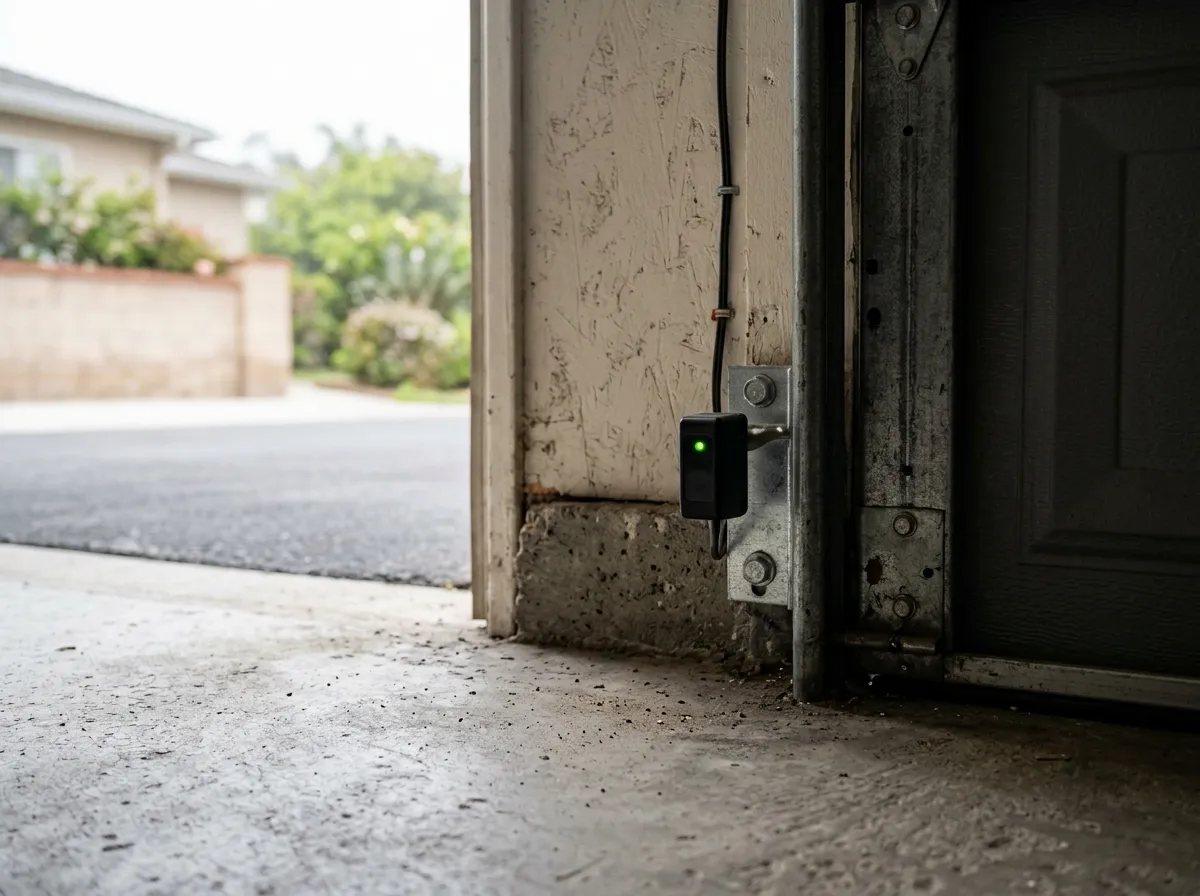
That pattern points at the safety sensors, the two small photo-eyes mounted a few inches off the floor on each side of the opening. One sends an invisible beam across to the other. When the receiving eye loses the beam, the opener assumes something is in the doorway and refuses to close. Openers sold from 1993 on must have this system, along with auto-reverse, under federal rules based on UL 325.
Many of these cases cost nothing to fix. Spend five minutes on the checks below before you book a visit.
Five checks that cost nothing
- Clear the beam. Look along the floor between the two eyes. A broom handle, a bin, a leaf or a cobweb is enough to break it.
- Wipe both lenses. Use a soft dry cloth. Dust and salt film build up on the glass.
- Read the two lights. Each eye has a small LED. Both should glow steadily. An LED that is off or flickering marks the side to look at.
- Check the brackets. A bike tire or a trash bin can knock an eye off its aim. Turn it gently by hand until the LED goes steady, then snug the wing nut.
- Notice the time of day. Low sun shining into the receiving eye can drown out the beam. If the door only misbehaves at certain hours, shade that eye with your hand and try again.
If the door now closes on a normal press, you are done. No visit needed. Our guide to a garage door that won’t close covers the other causes if these checks change nothing.
Never bypass the sensors Do not tape the two eyes together, move them up the wall, or close the door every day by holding the button. The beam is what stops a heavy door coming down on a child, a pet or the hood of a car.
When the checks do not fix it
| What you find | What it usually means |
|---|---|
| No light on one eye, or on both | No power is reaching it: a broken wire, a failed sensor or a fault at the opener |
| Wire chewed, pinched, or green at the terminals | Damaged or corroded low-voltage wiring |
| Bracket bent and will not hold its aim | The bracket needs replacing |
| Both lights steady, door still reverses | The sensors are fine and the cause is elsewhere |
That last row matters. A door that reverses with healthy sensors is reacting to resistance. The opener’s force limits may be off, a roller may be binding in the track, or a spring may be losing strength. Those are different jobs: see opener repair and spring repair. Stop running the door until it has been looked at.
What the technician does
- Tests for power. A meter at the sensor and at the opener’s terminals shows whether the eye, the wire or the opener is at fault.
- Traces the wire. The thin two-conductor wire runs from the opener down to each eye. Staples driven too tight, rodent damage and corroded ends are found by following it.
- Repairs or replaces. That can mean new wire ends, a new bracket, or a new pair of eyes matched to your opener’s brand.
- Aligns and tightens. Both eyes are set level, aimed at each other and locked so vibration will not shift them.
- Proves it. The door is closed with an object in the beam and must reverse. The auto-reverse on contact is tested as well.
You hear the price after the first step and before any parts go on.
What sensor repair costs
Nationally, Fixr’s 2026 cost guide puts garage door sensor repair at $85 to $250. That is a typical range, and the technician quotes before starting. Where a job lands depends on a short list:
- What failed. Realigning is the low end. New eyes and new wire cost more.
- The opener. Sensors have to suit the brand, and parts for some older units are harder to find.
- The wire run. Replacing a whole run takes longer than remaking one end.
- The real cause. If the sensors turn out to be fine, the repair is to the opener, track or spring, and it is quoted separately.
Repair the sensors or replace the opener
Sensors are a small part. When the opener itself is healthy, replacing a failed pair is the sensible repair.
Two situations change that. An opener sold before 1993 may have no photo-eyes at all, and adding parts to a unit that old is rarely worth it. And if the fault is in the opener’s circuit board, a new opener can make more sense than a new board. Any opener installed in California since July 1, 2019 must have battery backup, so a replacement brings that with it. See opener installation.
Sensor trouble in Carlsbad
Two local conditions make sensor faults more likely here.
Salt air. The eyes sit low, and their low-voltage wire terminals and steel brackets corrode in coastal air. A green crust on the copper or a rusted bracket that will not hold its angle produces an on-and-off fault that cleaning the lens does not cure.
Afternoon sun. On west-facing garages, late-afternoon light comes in low off the ocean and straight into the opening. If the receiving eye is on the sunny side, the door may refuse to close for part of the day. A technician can shade the receiver or swap the two eyes so the receiver faces away from the sun.
A photo-eye check is part of a tune-up. Sensor repair is available throughout Carlsbad and in neighboring Oceanside, Encinitas and Solana Beach.