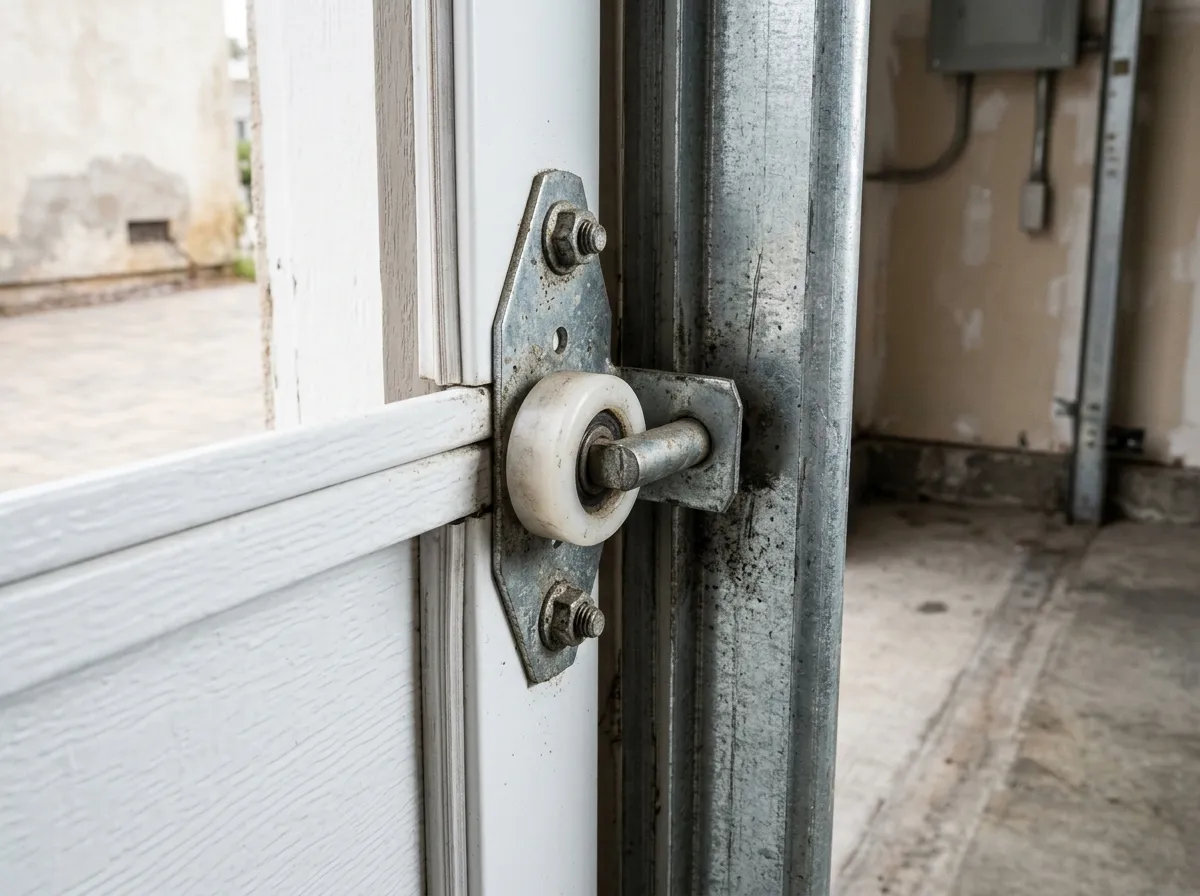
What a worn roller sounds like
Rollers are the small wheels that carry the door up and down its tracks. There is one at each hinge point along both sides. They do their work every time the door moves, and when they wear out you usually hear it first.
| What you notice | What is probably going on |
|---|---|
| Grinding or rumbling as the door travels | Bearings worn or rusted inside the roller |
| A high squeal | A dry bearing, or a stem turning dry in its hinge |
| The door shakes or jerks | A roller has seized and is dragging along the track |
| The door wobbles side to side | A wheel loose on its stem, or a worn hinge |
A noisy door is not always a roller problem. Loose hardware, a dry spring or a chain-drive opener all make their own racket, and a tune-up sorts out which is which. But if the noise comes from the sides of the door and follows it up the track, the rollers are the first place to look.
What you can safely check
Stand inside the garage, clear of the door, and run it once. Watch each roller in turn. You are looking for a wheel that slides without turning, one that tilts on its stem, or one with a chip out of its edge. With the door closed and still, look for cracks and for rust dust around the bearings.
If your rollers are steel and simply dry, a garage door lubricant on the bearings and hinge pins may quiet them. Do not use WD-40 as the lubricant, and keep your hands away from the tracks and the joints between sections whenever the door could move.
Leave the bottom rollers alone The bottom roller on each side sits in the bottom bracket, and that bracket also anchors the lift cable. The cable is under spring tension. Do not loosen or unbolt it. This part of the job is never a do-it-yourself swap.
Plastic, steel or sealed nylon
| Type | How it is built | What to expect |
|---|---|---|
| Plastic, builder grade | A plastic wheel on a steel stem with no bearings | The wheel wears against the stem, loosens and starts to wobble |
| Steel | A steel wheel on ball bearings, often unsealed | Strong and loud. Open bearings let in grit and moisture |
| Sealed nylon | A nylon wheel around sealed ball bearings | Quiet, and the bearings are protected |
Nylon is quieter for a plain reason: a nylon wheel on a steel track makes far less noise than steel on steel. The bearings matter just as much. A wheel that spins freely on ball bearings rolls. A wheel with no bearings drags a little on every trip, and the drag grows as it wears.
What worn rollers do to the rest of the door
A roller that drags makes everything else work harder. The opener pulls against friction it was not set up for. The tracks get scuffed where a seized wheel slides. Hinges take sideways load from a wobbling stem and their holes wear oval.
The worst outcome is a roller that leaves the track. A wheel that has broken up or come off its stem can let one side of the door drop out of line, and then you are dealing with an off-track door. Replacing rollers when they first get loud is the cheaper order to do things in.
How the replacement is done
- Inspection. The technician looks at every roller, the hinges, the tracks and the track brackets, and checks the springs and cables while there.
- Quote. You hear how many rollers need changing, which type is going in, and whether any hinges should go with them. The estimate is free.
- Securing the door. The door is disconnected from the opener and held so it cannot move.
- Upper and middle rollers. These are changed one hinge at a time, so the door stays supported throughout.
- Bottom rollers. The cable tension has to be dealt with before the bottom brackets are touched. This is the step that makes the job a technician’s.
- Hinges and track. Worn hinges are replaced, and track fasteners are tightened and the tracks checked for alignment.
- Test run. The door is run by hand and then on the opener. It should travel smoothly, and far more quietly.
What sets the price
We did not find a published price range for roller replacement that we would trust, so this page does not quote one. What you pay depends on these things:
- How many rollers. A full set costs more than replacing two bad ones, but less per roller than coming back later.
- Which type. Sealed nylon rollers cost more than plain steel or plastic.
- Hinges. Any that are cracked or worn are added to the job.
- What else is done. Rollers are often changed as part of a tune-up or alongside a cable repair, and the labor overlaps.
- Track damage. A bent or badly scored track is extra work.
The technician inspects the door and gives you a figure before starting.
Rollers alone, or more than rollers
If the door is sound and the tracks are straight, new rollers are all it needs. Mixing a few new ones with old ones works, but the old ones will be the next noise you hear, so a full set is usually the better buy.
If the door still grinds on new rollers, the cause is somewhere else. Ask the technician to check the spring, the bearings at the ends of the spring shaft, and the opener.
Roller wear in Carlsbad
Salt air is hard on steel rollers. Their unsealed bearings pit, then seize, and a seized roller is the one that grinds. Sealed bearings keep the damp out, which is the main reason nylon rollers suit a coastal garage. Our guide to salt air and garage door rust covers the other parts that corrode.
Noise matters more in some houses than others. In two-story tract homes with an attached garage, a bedroom often sits right above the door. An early start to the commute wakes whoever is sleeping there. In those homes, quieter rollers let people sleep.
Roller replacement is available across Carlsbad and in nearby San Marcos, Vista and Oceanside.
Rollers also wear faster where grit gets into the tracks, as on rural lots in Fallbrook, and where summer heat dries out the lubricant, as in Escondido.