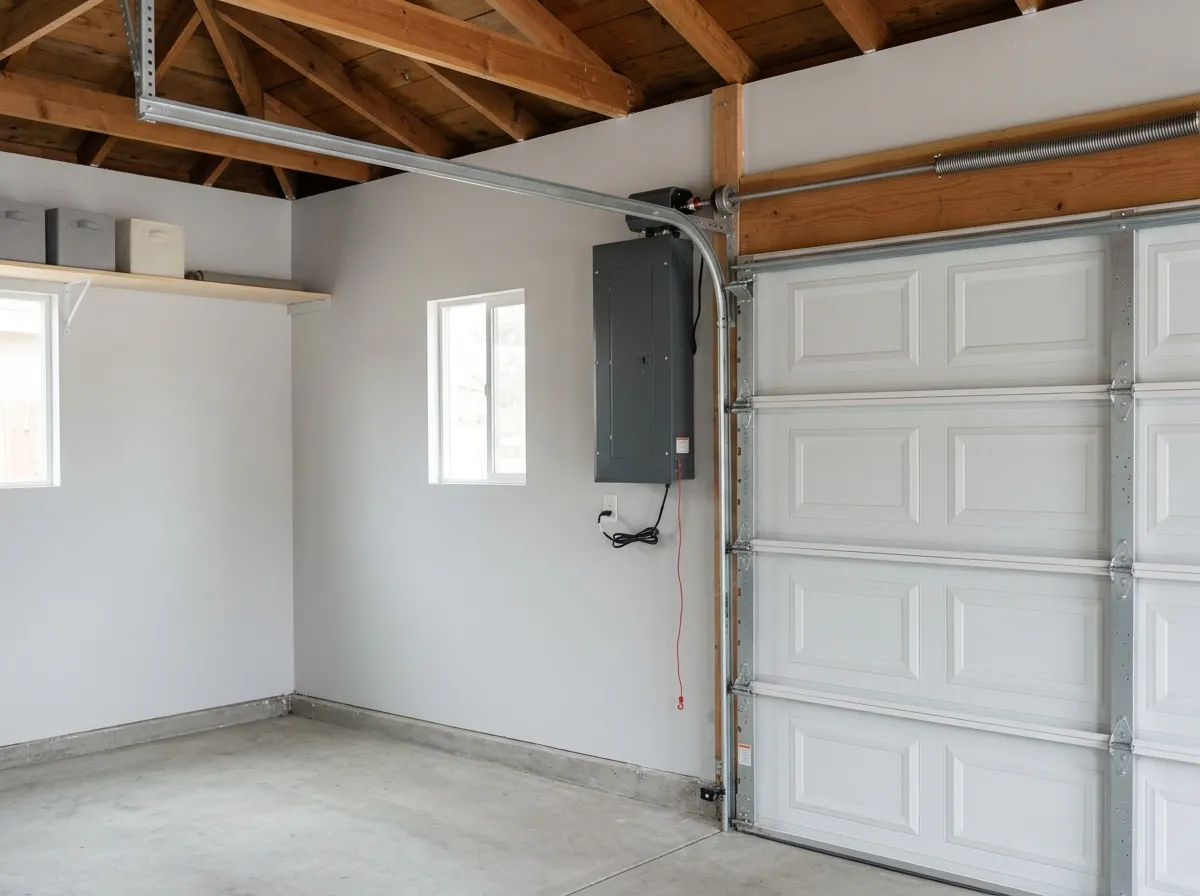
The California rule behind every new opener
Planning a garage door opener installation in Carlsbad starts with one fact most product pages skip. Since July 1, 2019, California law has barred anyone from selling or installing a residential automatic opener without a battery backup that works in a power outage. That is Health and Safety Code section 19892.
The same section has a second part that catches people out. A replacement garage door may not be connected to an existing opener that has no backup. If you are planning a new door and your opener is older than mid-2019, budget for both. Our post on the battery backup law walks through it.
The rule does not decide which drive type you pick. It decides that whichever one you pick comes with a battery.
Signs it is time for a new opener
- The unit is past about 15 years old and has started failing
- It has no photo-eye sensors near the floor, which means it was made before the 1993 federal safety rule
- It has no battery backup and you want the door to work in an outage
- A repair has been quoted at a large share of what a new unit costs
- The noise carries into a room you sleep in
What to check in your garage first
You do not need to measure anything precisely. A few observations help the technician recommend the right unit on the first visit:
- Look above the door. Note how much clear space sits between the top of the open door and the ceiling, and whether storage racks hang there.
- Look at the door. Single or double width, and steel, wood or insulated. Heavier doors need more from the opener.
- Find the outlet. A ceiling outlet near the middle of the garage suits a rail-mounted unit. A wall-mount unit needs power beside the door.
- Notice what is overhead. A bedroom or office above the garage changes which drive you want.
Leave the door hardware alone Fitting an opener means working beside the springs and the bracket above the door, both of which are under tension. Do not loosen or move them to make room for a new unit.
Choosing a drive type
| Drive | How it moves the door | Best suited to | Trade-off |
|---|---|---|---|
| Chain | A metal chain pulls a trolley along a ceiling rail | Detached garages, tight budgets | The loudest option |
| Belt | A reinforced belt does the same job | Garages with living space above or beside them | Costs more than chain |
| Screw | A threaded rod turns and carries the trolley | Owners who want few moving parts | Less common, so fewer models to pick from |
| Wall-mount | A motor beside the door turns the spring shaft | High-lift doors and ceilings used for storage | Needs a torsion spring shaft and wall space |
Power, door weight and smart features
Openers are sold by motor strength, and it is tempting to buy the biggest. The springs do the lifting. A correctly balanced door needs only a modest push, and the opener’s job is to move it and hold it closed. A wide wood or insulated door does call for a stronger unit than a single steel one. But if an old opener has been straining, check the springs before blaming the motor.
Many current models connect to home Wi-Fi so you can see whether the door is open and close it from a phone. Decide whether you will use that before paying extra for it.
What installation includes
- Balance check. The door is tested by hand first. An opener should never be fitted to a door that does not balance.
- Old unit out. The existing motor, rail and wiring come down.
- Rail and header bracket. The new rail is assembled and fixed to a bracket above the door, and the motor is hung from the ceiling framing. A wall-mount unit goes on the shaft instead.
- Photo-eyes. New sensors are mounted a few inches off the floor on both sides and aligned.
- Travel and force. The technician sets where the door stops and how hard it pushes before reversing.
- Safety tests. Auto-reverse and the photo-eyes are tested, then the backup battery, remotes and wall control.
A standard replacement is normally a single visit. You get a quote before anything is taken down.
What a new opener costs
HomeAdvisor lists the average garage door opener installation in San Diego at $417, with a typical range of $206 to $567. Nationally, Fixr’s 2026 guide puts a standard opener at $250 to $600 and a smart opener at $600 to $1,200. These are directory and guide figures. The technician’s quote for your garage is the real number, and it comes before work starts.
The price moves with:
- Drive type. Chain is the least expensive. Belt and wall-mount cost more.
- Door size and weight. A heavy double door needs a stronger unit.
- Wiring. A missing outlet or damaged sensor wire adds work.
- Features. Wi-Fi, cameras and extra remotes add to the total.
New opener or one more repair
Replace when the unit is old, lacks safety sensors, or needs a part that costs a good share of a new opener. Repair when it is fairly recent and one component has failed. If the only complaint is a door that reverses on the way down, the fix may be a sensor adjustment.
Opener installation in Carlsbad
Two local points shape the choice. Many of the city’s two-story tract homes have a bedroom over the garage. In those houses a belt drive is worth the extra cost, because a chain’s rattle travels through the ceiling framing.
The second is power. The power can go out in fire weather, and Carlsbad’s Very High fire hazard zone covers 8,170 acres on the 2025 state map, up from 4,840 in 2011. The backup battery is what lets you get the car out when the grid is down. Ask how to tell when yours needs replacing.
Installation is available across Carlsbad and inland in Escondido, Rancho Santa Fe and Fallbrook.