California's garage door opener battery backup law, explained
What SB 969 requires, what it leaves alone, and how to check that your own opener will lift the door when the power is out.
Published
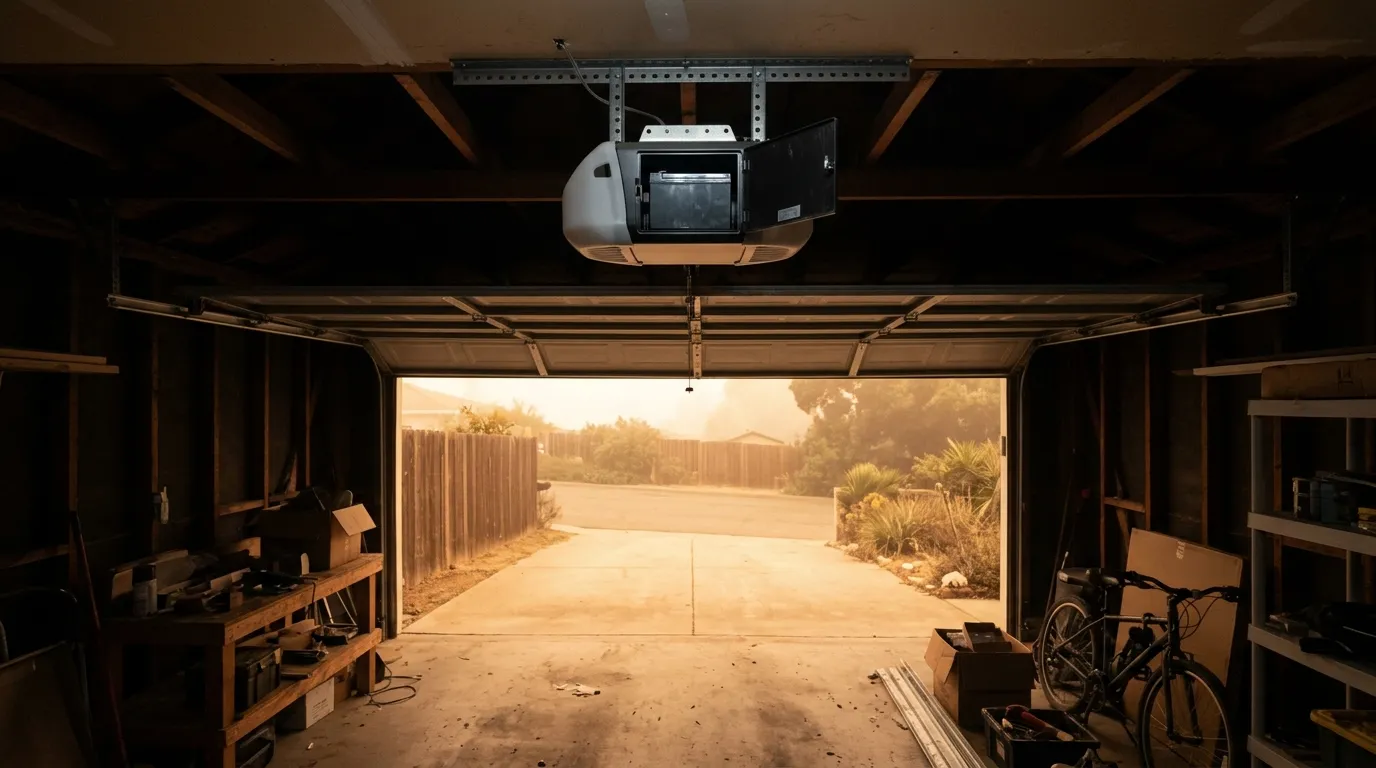
Since July 1, 2019, every residential automatic garage door opener sold or installed in California must have a battery backup that works during a power outage. A replacement garage door also may not be connected to an existing opener that lacks one. The rule came from SB 969 and sits in Health and Safety Code 19892.
What the statute says, by situation
Two subdivisions do the work. Subdivision (a) covers selling and installing openers. Subdivision (c) covers new doors.
| Your situation | What Health and Safety Code 19892 means for you |
|---|---|
| You are buying or installing a new opener | It must have a battery backup that works in an outage, under (a) |
| You are replacing the door and the opener has a backup | The opener can be reconnected to the new door |
| You are replacing the door and the opener has no backup | The new door may not be connected to it, under (c). Plan for a new opener |
| You are keeping a working older opener on its existing door | The law does not make you replace it on its own |
This is general information. The section is short and worth reading in full if money rides on it. If a new opener is where you are headed, the garage door opener installation page covers the options.
What the law leaves alone
If yours went in before July 2019 and still works, you can keep using it. The requirement applies at two moments: when an opener is sold or installed, and when a replacement door goes up.
On penalties, be careful what you read. Linear, an opener manufacturer, says in its FAQ on SB 969 that a violation carries a $1,000 penalty per opener. We could not confirm the amount from the statute text we relied on, so we attribute it to Linear and leave it there. The duty sits with the seller or installer in any case.
Why California passed it
Wildfires knock out power. In past California fires, people found they could not get their garage doors open to drive out. An opener with no battery is dead in an outage, and the manual release is unfamiliar to many people, more so in the dark. SB 969 was the legislature’s answer: make every new opener able to lift the door on its own stored power.
Does your opener have a battery backup
Four ways to find out, quickest first:
- The install date. An opener sold or installed in California since July 1, 2019 should have one.
- The motor unit. Look for a battery compartment or cover on the housing, and for a battery status light.
- The label. Write down the model number from the unit and look it up in the maker’s manual, which lists it.
- A test. See below. It settles the question.
How to test the backup
- Close the door and clear the doorway.
- Unplug the opener from the ceiling outlet.
- Press the wall button. The door should open, and close again on a second press.
- Plug the opener back in.
If nothing moves with the cord out, either there is no backup or the battery is flat. Do this once before fire season.
The beeping opener and battery replacement
A repeating beep from the motor unit usually concerns the backup battery. It is low, it is worn out, or the opener is running on it because the power is off. The pattern differs by brand and model, so match it to the chart in your manual.
Backup batteries typically last a few years. The manual gives the expected life for your model and the replacement part number. On most units the battery sits behind a cover and unplugs, and the manual walks you through the swap. If the opener keeps beeping with a new battery, or the new battery goes flat quickly, the fault is in the opener and it is an opener repair job.
Opening the door by hand in an outage
If the opener has no backup, or the battery is dead, the red cord is how you get out. It hangs from the trolley on the opener rail and disconnects the door from the opener.
Only with the door fully down Pull the red release cord only when the door is closed. If the door is open or partly open and a spring is weak or broken, releasing it can let the door fall. If the door feels heavy when you start to lift, stop and set it back down.
With the door closed, pull the cord, then lift the door from the handle or the bottom edge. A door with sound springs feels light and stays where you leave it. Raise it fully before you drive under it. Your manual shows how to reconnect the trolley once the power is back.
Practice this once in daylight. Make sure everyone in the house who drives knows where the cord is.
Why this matters in Carlsbad
The State Fire Marshal’s 2025 map puts 8,170 acres of Carlsbad in the Very High fire hazard zone. The 2011 map showed 4,840. The Poinsettia Fire in 2014 triggered 11,600 evacuation notices, and the Cocos Fire was burning in San Marcos the same week.
If your car is in the garage when a notice comes and the power is already off, the door has to open on the first try.
If you are replacing an opener or a door
A new opener comes with the backup by law, so the choice left to you is drive type. Belt drives are quieter than chain drives. Wall-mount openers free up the ceiling. HomeAdvisor’s San Diego average for opener installation is $417, with a typical range of $206 to $567. That is a directory figure, and the technician quotes before starting.
If a new door is the plan, check the opener before you order. Our post on garage door replacement cost lists the other California items that affect the budget. To have someone look at your opener and tell you whether it complies, start with opener installation in Carlsbad. Estimates are free, and the line is answered at any hour.