Garage door rust and salt air: a guide for coastal Carlsbad homes
Where coastal rust starts on a garage door, how far inland it reaches, and how to tell a paint problem from a part that could fail.
Published
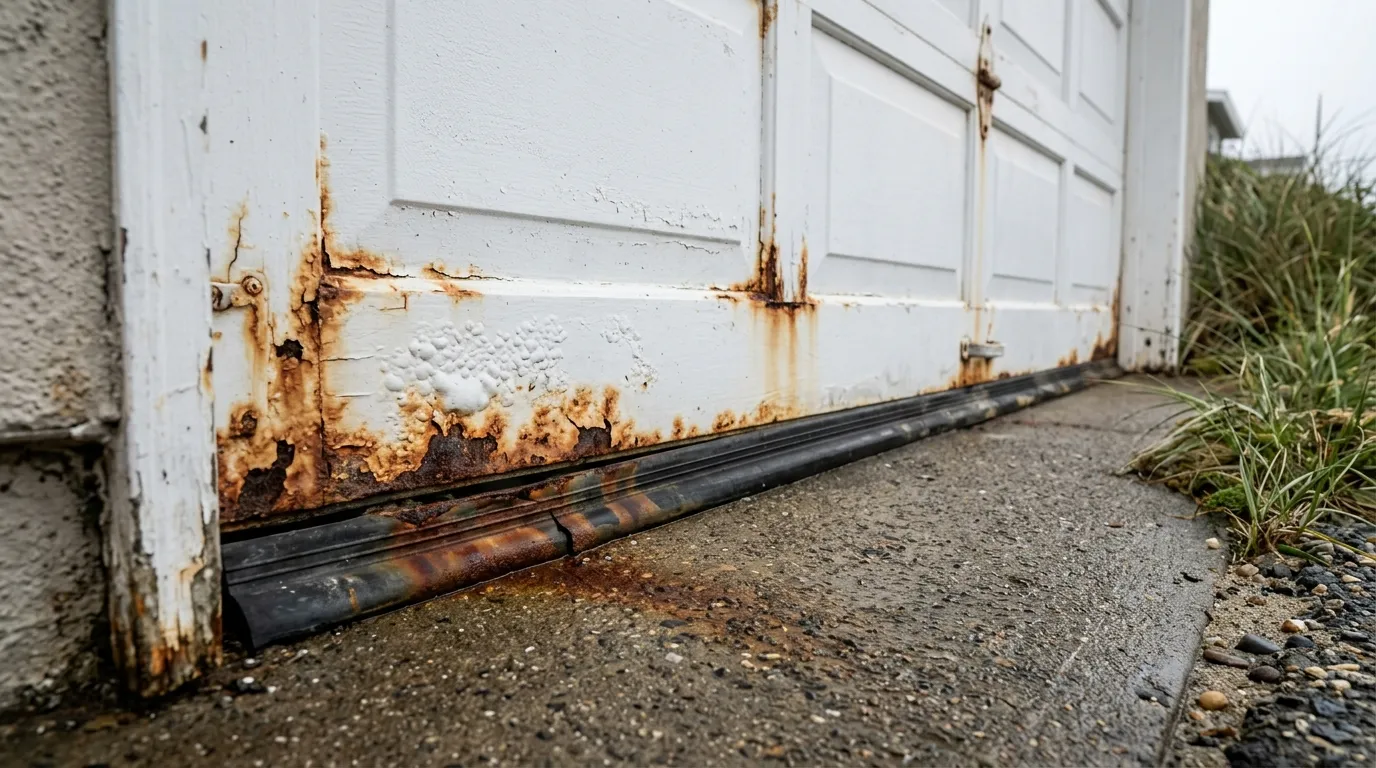
Garage door rust starts where salt and moisture sit: the bottom section, the bottom brackets, cable ends, hinges, roller bearings and spring coils. Surface rust on a panel is cosmetic. Rust on cables, brackets and springs is a safety issue, because those parts hold the weight of the door under tension.
Why the bottom of the door goes first
Salt arrives as fine spray and settles. Rain and fog carry it downward, and it collects wherever water lingers. On a garage door that means the lowest foot.
The bottom edge of the last section sits in whatever puddles on the slab. The bottom brackets are bolted to that edge, and the lift cables loop onto them, so the cable ends spend their lives in the dampest corner of the garage. Hinges and roller bearings hold moisture in their joints. Spring coils trap it between turns, out of sight.
The broad face of the door, which is what you see from the street, dries fastest. A door can look fine from the driveway while its cables are in poor shape, which is why a garage door tune-up starts at the bottom corners.
How far inland salt air matters
Nobody has published a corrosion study for the San Diego coast that we could find, so there is no local line on a map. What exists are general benchmarks, and they do not agree:
- A FEMA bulletin, as summarized by Ask the Builder, places the heaviest corrosion roughly 300 to 3,000 feet from the shore.
- An article in Structure magazine gives a structural engineering rule of thumb of 1.25 miles.
- Raynor, a door manufacturer, excludes saltwater coastal areas within two miles from its warranty.
The figures differ, but they agree on the pattern. Close to the water the effect is strong, it fades with distance, and it is still worth watching for well past the first few blocks.
Why Carlsbad is hard on door hardware
Heat is not the problem here. NOAA’s climate normals put the average August high at Palomar Airport at just 75.8F. Summer fog comes in off the Pacific, and without hot afternoons to burn it off, metal stays damp for hours. Damp metal rusts faster.
The most exposed parts of the city are Carlsbad Village, Olde Carlsbad and the edges of the lagoons, where the air has water on more than one side.
Age adds to it. Census figures for 92008 show a median build year of 1980, with 26 percent of homes built before 1970. That is the oldest housing in Carlsbad, sitting in the saltiest air. Original hardware there has had decades of exposure. The same ocean air reaches Oceanside to the north and Encinitas to the south.
A five-minute look at your own door
Do this with the door closed and the opener left alone. Look. Do not loosen anything.
- Bottom edge. Run your eye along the lowest few inches of the door, inside and out. Bubbling paint and orange streaks mean rust under the finish.
- Bottom brackets. These are the metal plates at the two lower corners where the cables attach. Check for flaking or swelling.
- Cables. Follow each cable up from its bracket. Look for rust-colored strands, fraying or a single broken wire sticking out.
- Hinges and rollers. Rust stains running down from a hinge, or a roller that looks seized, are worth noting.
- Springs. Look at the coil above the door. Brown dust between the turns is rust.
Do not unbolt the bottom brackets The lift cables are anchored to them and the springs keep those cables under tension. Removing a bracket bolt can release that force. Look at brackets, cables and springs as closely as you like. Leave the wrenches out of it.
Repair or replace, by where the rust is
| Where the rust is | What it means | Usual answer |
|---|---|---|
| Panel face: spots, chips, scratches | Cosmetic | Sand, prime and touch up the paint |
| Bottom edge of the bottom section: flaking or holes | The section is losing strength | Replace that section if a match is still made. Otherwise a new door |
| Hinges and rollers | Noise and binding, more load on the opener | Replace the worn parts |
| Lift cables: any rust or broken strands | Safety issue | Stop using the door. Technician replaces the pair |
| Bottom brackets | Safety issue. The cable anchor is weakening | Technician only |
| Spring coils | Light rust adds friction. Pitting shortens spring life | Light rust is lubricated at a tune-up. Pitted springs are replaced |
For scale, Fixr’s 2026 national guide puts panel replacement at $250 to $1,000 and cable repair at $100 to $400. Those are typical ranges from a cost guide. The technician prices your door after looking at it, before any work starts.
If a single section is the casualty, see garage door panel replacement. Rusted cables are covered on the cable repair page.
What you can do yourself
Rinse it. Hose the outside of the door with fresh water every so often and wipe the inside of the bottom section with a damp cloth, paying attention to the corners. You are washing salt off before it works.
Touch up chips early. A chip in the finish is where panel rust begins. Sand it, prime it and paint it while it is small.
Lubricate. Use a garage door lubricant on hinges and roller bearings. WD-40 is a cleaner, not a lasting lubricant. The oil film keeps moisture off the steel. Spring coils are lubricated during a tune-up.
Keep the slab dry. Sweep out standing water and leaves along the threshold so the bottom seal is not sitting in a puddle.
A yearly tune-up covers the lubrication and adds a check of the cables, brackets and spring balance by someone who knows what early failure looks like.
What to ask for when you replace parts or the door
Corrosion resistance is mostly decided at purchase, so ask for it by name.
- Galvanized or stainless steel hardware: hinges, brackets and cables
- Sealed nylon rollers, which keep salt out of the bearing
- An aluminum or composite door if you are replacing the whole thing
Then read the manufacturer’s coverage terms. Raynor’s two-mile exclusion is described above. Amarr’s residential warranty excludes surface rust and cosmetic corrosion. In practice, a coastal homeowner should assume rust is theirs to prevent and choose materials on that basis. Our post on garage door replacement cost covers the budget side, and the installation page covers the choices.
When to have someone look
Cosmetic rust can wait for a dry weekend. Rust on a cable, a bottom bracket or a spring should not wait, and the door should stay down until it is seen.
A licensed local technician can come out the same day, check the hardware and tell you which parts need replacing and which only need cleaning and oil. The estimate is free. For a routine check, book a tune-up. If a cable has already frayed or the door is hanging crooked, call any hour.